

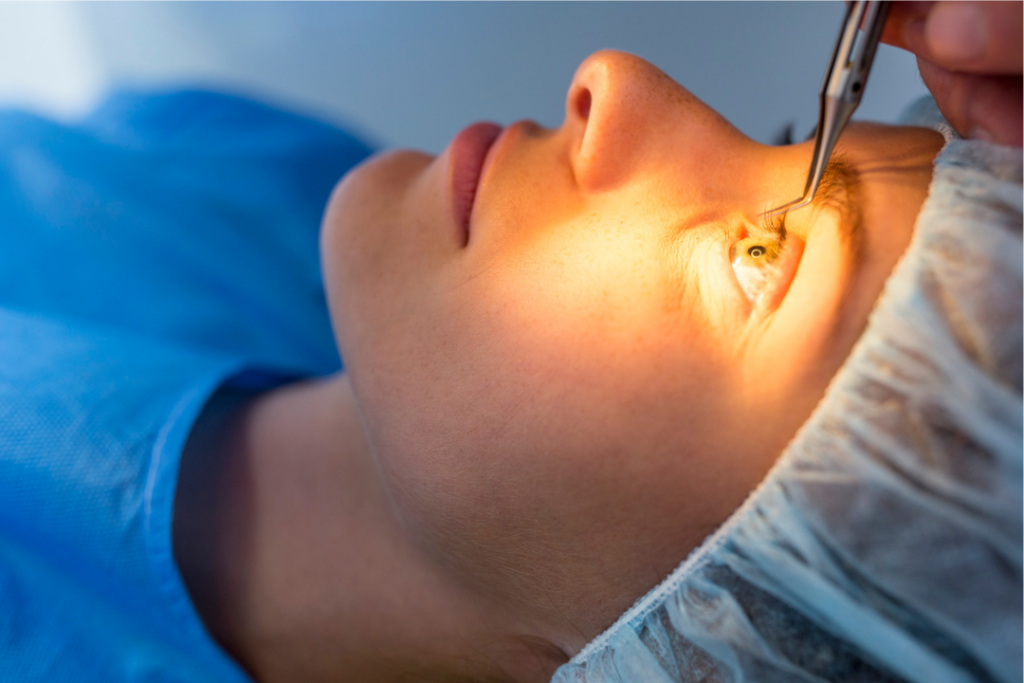
What is Refractive Surgery?
Refractive surgery encompasses a variety of procedures aimed at correcting vision by reshaping the cornea, the eye’s clear, dome-shaped front surface. The primary goal of these surgeries is to adjust the way light rays enter the eye so they focus directly on the retina, providing clear vision without the need for glasses or contact lenses.
Understanding the Cornea
The cornea plays a crucial role in vision. As the transparent, outermost layer of the eye, it acts as a window that controls and focuses the entry of light into the eye. A healthy, properly shaped cornea is essential for clear vision, as it helps to bend (refract) the light rays so they focus precisely on the retina at the back of the eye.
Types of Refractive Surgery
LASIK (Laser-Assisted In Situ Keratomileusis) LASIK is one of the most common and well-known refractive surgeries. It involves creating a thin flap in the cornea, then using a laser to remove a precise amount of corneal tissue underneath. This reshaping allows light to be more accurately focused onto the retina, improving vision.
PRK (Photorefractive Keratectomy) PRK is a laser eye surgery similar to LASIK, but it does not involve creating a flap. Instead, the outer layer of the cornea is removed, and the underlying corneal tissue is reshaped with a laser. The outer layer then regenerates over time. PRK is often recommended for patients with thinner corneas.
LASEK (Laser Epithelial Keratomileusis) LASEK combines elements of both LASIK and PRK. It involves loosening the outer layer of the cornea with an alcohol solution, then reshaping the underlying tissue with a laser. The outer layer is then repositioned and allowed to heal.
SMILE (Small Incision Lenticule Extraction) SMILE is a minimally invasive procedure where a laser is used to create a small, lens-shaped piece of tissue (lenticule) within the cornea. This lenticule is then removed through a tiny incision, changing the shape of the cornea and correcting vision.
Benefits of Refractive Surgery
Clear Vision Without Glasses or Contacts Refractive surgery aims to reduce or eliminate the need for glasses or contact lenses, providing the freedom to enjoy daily activities with improved visual clarity.
Long-Lasting Results Most patients experience long-lasting vision correction, though vision may change naturally with age. Refractive surgeries often provide a permanent improvement in vision.
Quick Recovery Many refractive surgeries, particularly LASIK, offer a rapid recovery time. Most patients notice an improvement in their vision within a day or two and can return to their normal activities shortly after the procedure.
The Cornea and Refractive Surgery Experience
Comprehensive Eye Examination Your journey begins with a thorough eye examination to determine the health of your cornea and your overall suitability for refractive surgery. Our specialists will assess your vision needs and discuss the best surgical options for you.
Personalized Treatment Plan Based on the examination, a personalized treatment plan is developed to address your specific vision correction needs. Our team will guide you through the entire process, ensuring you are informed and comfortable with your chosen procedure.
Advanced Surgical Techniques At Smart Vision Hospital, we employ the latest in laser technology and surgical techniques to ensure precision, safety, and optimal results for our patients. Our experienced surgeons are dedicated to providing the highest standard of care.
Post-Operative Care After your surgery, we provide comprehensive follow-up care to monitor your healing process and ensure the best possible outcome. Our team is available to address any questions or concerns you may have during your recovery.
Empower Your Vision with Refractive Surgery!
Achieve clearer vision and enjoy life without the dependence on glasses or contact lenses. Schedule a consultation with our experts at Smart Vision Hospital to explore your options for cornea and refractive surgery and take the first step toward a brighter, clearer future.
See Clearly, Live Fully!
FAQs on Cornea and Refractive Surgery
What is corneal transplant surgery?
For opaque corneas due to various causes, to restore useful vision we take healthy corneas from dead people and transplant it to the recipient. This is corneal transplant surgery. Eye must be retrieved from the dead within 6 hrs of death for transplantation.
Why should I go for a refractive eye surgery?
If you are dependent on glasses or contact lenses for clear vision, then you can be off them after refractive surgery. Your cosmetic appearance will also improve boosting your confidence.
What are the different types of refractive laser eye surgery?
Different types of refractive laser surgery include the routine customised lasik using microkeratome, Femtolasik ,Epilasik and SMILE.
Will there be any side effects after a laser eye surgery?
The usual side effects of any refractive surgeries are glare, halo, dryness of eyes, small under/overcorrections etc. Sight threatening problems are rare. The minimal side effects usually disappears with wound healing.
What is the best type of refractive eye surgery?
The best type of refractive surgery for the patient can be determined only after knowing the corneal thickness and oculyzer for the patient.
Can I get the treatment for both the eyes at one time?
Definitely. Most of the people in general go for surgery in single sitting and get cured once for all.
Will I be able to drive back home on my own after surgery?
Definitely No. Generally it takes few hours for your eyes to settle down. In some cases people would have taken a mild sedative before surgery. So it is always advisable to take someone’s help driving home. However you can do so the next day unless your doctor has advised you not to drive.
Should I have to restrict myself from doing activities relating to eyes?
Generally you will be advised to stay away from visually demanding activities for a minimum of 2 days after your surgery. In some cases, it may be extended to even 3 days. From your end, you can also check with your doctor on what kind of activities are allowed.
Should I avoid water falling on my eyes?
Yes, it is recommended that you should be very careful when washing your hair and face for atleast a week after surgery.
What kind of common complications that will arise after a refractive surgery?
Mostly people may have face a situation of either over-correction or under-correction. However, both these issues can be treated. For some the usage of spectacles and contact lenses should be used for doing certain activities.
Will I get a stable vision after a refractive surgery?
After a refractive surgery, there will be slight fluctuations in the first few days. However, after 3 to 6 months it will be alright for most of the patients.
What is eye donation?
Eyes can be retrieved after death within 6 hours and can be stored in media. The cornea and selera can be used for indicated patient to restore vision.
National Eye Donation Fortnight
25th August to 8th September





 Dr. Susan Verghese